Updated: September 19, 2026
For years, East Austin has been one of the most talked-about real estate stories in the city.
Depending on who you ask, that story has usually centered on residential growth, neighborhood change, rising land values, restaurant openings, creative culture, or the steady eastward movement of Austin’s development energy. All of that still matters. But I think the next chapter of East Austin may be less about another wave of residential demand and more about something deeper: the infrastructure of entrepreneurship.
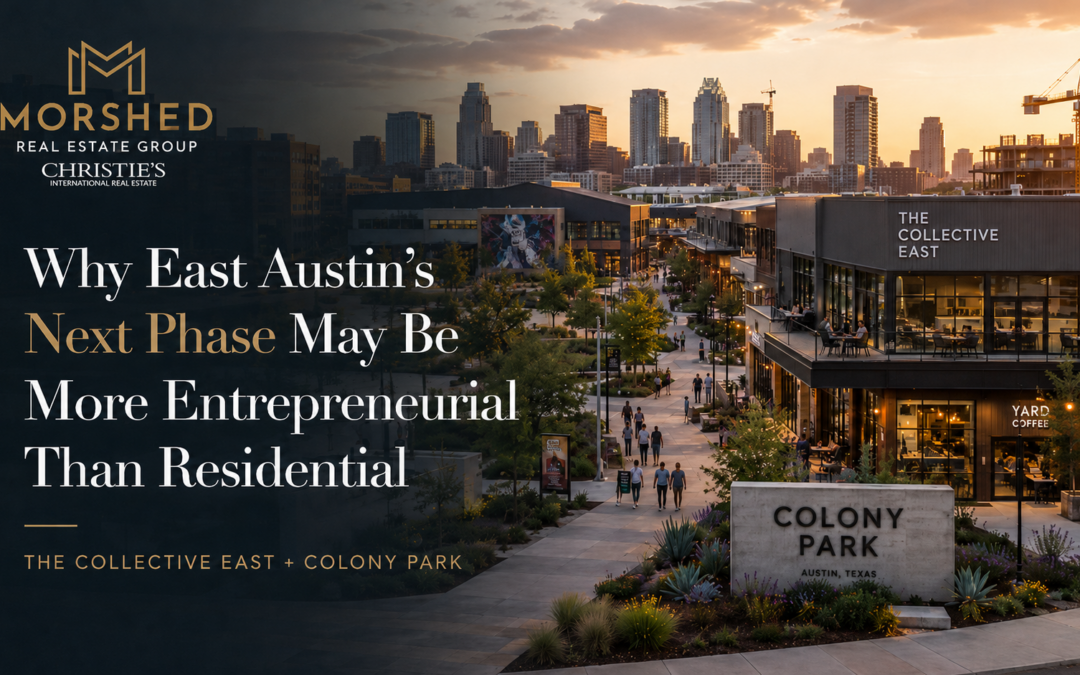
That is why The Collective East, a new commercial development near Colony Park, is worth paying attention to.
At first glance, it may look like another office, retail, and flex-commercial project. But projects like this help tell us where the city’s growth is maturing, where local businesses may begin to cluster, and where long-term real estate value could be supported by more than just rooftops.
One distinction is important. The Collective East and Colony Park are separate but adjacent developments. The Collective East is a privately developed commercial project at 7000 Johnny Morris Road. Colony Park is the larger master-planned community being developed through a public-private partnership on 208 acres of city-owned land.
Their proximity is what makes the real estate story particularly interesting.
A Commercial Project Built for How Austin Businesses Operate
The Collective East is being developed by Spark Root and leased by ECR. The project includes approximately 152,000 square feet of office, retail, workshop, and flex space across seven buildings on nine acres.
More than 100 suites are planned, ranging from approximately 725 square feet to more than 38,000 square feet. The first three buildings are expected to deliver between the fourth quarter of 2026 and the first quarter of 2027, and the project is currently pre-leasing.
The design is notably different from a conventional office complex. Commercial Services zoning allows combinations of warehouse, workshop, office, and retail uses. Select suites will include garage doors, mezzanines, ceilings up to 20 feet, robust electrical service, and layouts that can support production as well as client-facing operations.
That creates options for businesses that do not fit neatly into traditional retail, office, or industrial categories. A designer could combine a showroom and studio. A wellness operator could have an open treatment or fitness area with a retail component. A fabricator, photographer, architect, hospitality concept, or growing consumer brand could combine production, fulfillment, office, and customer experience in one location.
Spark Root also brings a relevant track record. Its marketing materials identify The Collective South Congress, SoCo Studios, and The Offices at Bell North as fully leased projects serving more than 40 tenants. That does not guarantee the same result here, but it suggests this is not the developer’s first attempt at creating flexible commercial space for smaller operators.
One detail that has not been made public is asking rent. ECR’s current listings direct prospective tenants to contact the brokerage for pricing rather than publishing a rate.
That means anyone evaluating the project should look beyond the quoted base rent and ask about triple-net charges, common-area expenses, tenant-improvement allowances, delivery condition, lease term, and the total effective occupancy cost. Those numbers will tell us far more about initial demand than a rendering or construction announcement will.
Why the City-Owned Colony Park Land Matters
The adjacent Colony Park project changes the scale of the conversation.
The City of Austin describes Colony Park as a mixed-income, mixed-use community planned for 208 acres of city-owned land. The City selected Catellus and Banbury Development as its master-development partners and signed the formal development agreement in August 2024.
Catellus is particularly notable because it also partnered with the City on Mueller, one of Austin’s most significant examples of transforming publicly owned land into a mixed-use community.
Current public materials vary based on the phase and version of the plan. The Colony Park project website describes more than 1,500 homes and over 200,000 square feet of retail, while the City’s broader planning materials contemplate approximately 2,000 to 3,000 single-family and multifamily homes along with office, retail, parks, civic space, and community services.
The exact final numbers may continue to evolve, but the consistent point is scale. This is not a single apartment development or isolated retail center. It is a long-term effort to create a more complete neighborhood.
Because the City owns the land and is participating in the planning, infrastructure, financing, and public amenities, this is also different from a developer assembling scattered parcels and hoping services eventually follow.
That does not eliminate execution risk. Public-private projects can move slowly, and Colony Park has already been discussed for many years. But the development agreement, zoning framework, financing tools, and active development partnership move it beyond a purely speculative concept.
Homebuilders and pricing for the new Colony Park homes have not yet been announced. The project’s current FAQ says that information is expected around late 2026. That is another milestone worth watching because the builder mix, price points, affordable-housing requirements, and release pace will help define who the community ultimately serves.
What Current Prices and Rents Tell Us
The nearby residential market still presents a substantial pricing gap compared with Austin overall.
As of September 2026, current listing data showed a median asking price of approximately $299,000 among a relatively small group of homes for sale in Colony Park. By comparison, Austin’s median sale price during the three months ending in August was approximately $550,000.
Those are not perfectly equivalent measurements. One is a neighborhood asking price based on limited inventory, while the other is a citywide closed-sale figure. Still, the difference helps explain why investors and value-focused buyers are watching northeast Austin.
Rental data deserves similar context. Realtor.com recently showed a broader 78724 rental benchmark near $2,000 per month, while current three-bedroom house listings within Colony Park ranged from approximately $1,850 to $2,500 per month.
Using a $299,000 purchase price and $1,997 monthly rent produces a rough gross annual yield of approximately 8%. But gross yield is not cash flow. Property taxes, insurance, repairs, vacancy, management, financing, and the actual condition of the home can materially change the result.
That is why the investment thesis cannot simply be “buy before Colony Park is built.” A property should make sense based on today’s purchase price and realistic current rent, with future development treated as potential upside rather than the only reason the deal works.
The Real Estate Play Is More Specific Than “Buy East Austin”
For residential investors, the most defensible play may be an existing home purchased at a reasonable basis and held through the area’s longer development cycle.
This is more likely to be a five-to-ten-year strategy than a quick appreciation play. The strongest candidates will generally be properties that already appeal to renters, have manageable repair needs, and can perform without relying on aggressive rent growth. Investors should compare individual streets, tax burdens, insurance costs, property condition, and achievable rents rather than applying a single Colony Park narrative to every property in 78724.
For owner-occupants, the opportunity may be purchasing at a lower basis than many other areas within Austin city limits while gaining exposure to future services, commercial activity, parks, and neighborhood improvements. That buyer may be able to tolerate slower development better than an investor depending on immediate appreciation.
For entrepreneurs and business owners, The Collective East presents a different kind of real estate play. It is currently a leasing opportunity rather than a for-sale commercial investment, but it could allow an operator to establish a presence before the surrounding residential and retail ecosystem is fully built out.
Nearby commercial property may also become more interesting, particularly for uses that benefit from both daytime business activity and a growing residential population. Food and beverage, child care, health and wellness, professional services, neighborhood retail, building trades, and showroom concepts are logical categories to watch.
Raw land is the more speculative play. Any nearby parcel should be evaluated based on existing zoning, utility access, drainage, road frontage, environmental constraints, and realistic entitlement timing. Paying a premium solely because it is “near Colony Park” can turn a promising long-term thesis into a weak investment.
It is also important to understand that the 208-acre Colony Park site is city-owned. Investors are not simply purchasing pieces of the master-planned property. The more realistic opportunities are existing homes, infill sites, and privately owned parcels or commercial properties in the surrounding area.
Infrastructure Matters, but Timing Matters More
Transportation is another part of the thesis, but it requires nuance.
CapMetro opened the Expo Center Park & Ride and launched full-frequency Rapid 837 service in June 2026, providing peak service as often as every ten minutes between northeast Austin, the University of Texas area, and downtown. That is an operating improvement investors can evaluate today.
The proposed Green Line is different. Although long-term maps show commuter rail connecting downtown with Colony Park, current reporting indicates that the project has no construction funding, environmental review, or delivery timeline.
In other words, the Green Line may remain part of the long-term vision, but it should not be used to justify a purchase price today. A disciplined investor should underwrite the transit, access, and road network that currently exist, then treat future rail as optional upside.
The Signals I Would Watch Next
The next phase of the investment story will depend on execution. I would pay particular attention to:
- Actual leases signed at The Collective East and the types of businesses committing to the project
- Published asking rents, concessions, and tenant-improvement packages
- On-time delivery of the first three commercial buildings
- Colony Park’s homebuilder announcements and initial residential pricing
- Infrastructure construction and the release of residential and commercial phases
- Retail, grocery, health care, and service commitments that create everyday utility
- Whether existing home rents and resale demand begin strengthening before prices move substantially
Those signals will help distinguish durable neighborhood growth from optimism that has already been priced into the market.
What This Means for Luxury Buyers and Executives
For executives, entrepreneurs, and high-net-worth buyers, the relevance may be less about purchasing a primary residence in Colony Park and more about understanding where Austin’s economic activity is moving.
A residential decision is rarely only about the house. It is also about access, services, employment, mobility, lifestyle, and the long-term strength of the market around it.
East Austin has already shown that culture, proximity, and lifestyle can reshape demand. The next question is whether northeast Austin can add enough commercial, civic, and neighborhood infrastructure to support a broader and more durable form of growth.
The Collective East and Colony Park are two different projects, but together they offer an early look at how that ecosystem could develop.
The Bigger Austin Lesson
Austin’s next real estate opportunities may not always be hiding in the most obvious places.
A lot of people wait until a neighborhood is fully validated before they pay attention. By then, the best risk-adjusted opportunities may be gone. But buying early does not mean buying blindly.
A more strategic approach is to separate what is funded and under construction from what is merely proposed. It means comparing current pricing with realistic rents, understanding the actual developer and public partners involved, and choosing a property that can perform even if the larger vision takes longer than expected.
The Collective East is under construction. Colony Park has a signed development agreement and an experienced master-development team. New transit service is operating. At the same time, commercial rents, new-home pricing, major tenant commitments, and several important timelines remain unresolved.
That combination creates opportunity, but it also calls for discipline.
East Austin is not just adding more places to live. It is adding more places to build, work, serve customers, and grow businesses.
For a city driven by entrepreneurs, that may be the more important story.