Austin’s skyline is not done changing.
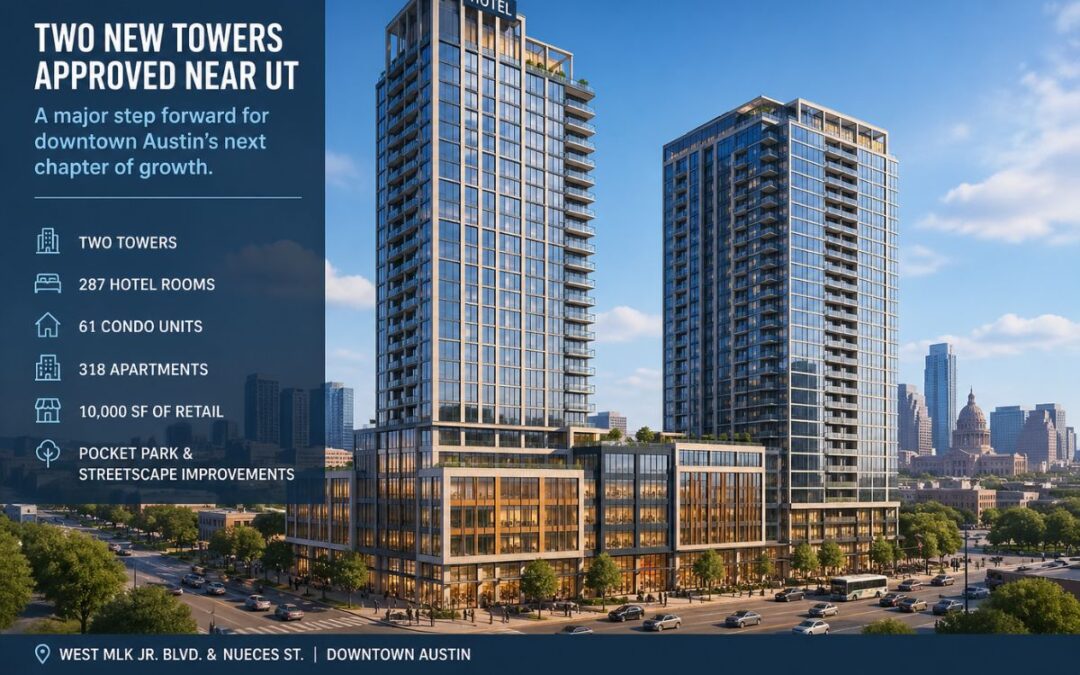
The latest example is a newly approved two-tower redevelopment near the University of Texas, along West Martin Luther King Jr. Boulevard between Nueces and Rio Grande streets. The project, led by Austin-based Rundog Real Estate Group, would bring a mix of hotel rooms, condos, apartments, and ground-floor retail to a full downtown block near UT, West Campus, and Judges Hill.
For anyone watching Austin real estate, this approval is more than just another high-rise headline. It is a good example of where the city is headed: more density near major employment, education, walkability, transit access, and downtown amenities.
In my view, the bigger story is not just that two towers were approved. It is what this says about the continued demand for well-located real estate in central Austin.
What was approved?
Austin City Council voted on March 26 to approve additional entitlements for the project through the Downtown Density Bonus Program. City documents show the request increased the allowable floor-to-area ratio from 5:1 to 20:1 and the maximum building height from 120 feet to up to 445 feet for the unified development.
Current plans reported for the project include a 37-story north tower with a 287-room hotel, 61 condo units, and about 5,000 square feet of retail space. The south tower is planned as a 34-story apartment tower with 318 apartments and another 5,000 square feet of retail frontage.
The site currently includes several lower-rise buildings and businesses, including a Jack Brown Cleaners, a Jimmy John’s, and the original Tiff’s Treats location. That local detail matters because it shows the type of transition Austin is seeing in some central locations: older low-rise commercial blocks becoming larger mixed-use projects.
Tarek’s Take:
“The skyline gets the attention, but the real story is land use. Austin is continuing to move toward more density in places where people already want to live, work, study, and spend time.”
Why this location matters
This project sits in a particularly important part of Austin.
It is near the University of Texas, close to West Campus, adjacent to downtown, and near the Judges Hill neighborhood. That puts it at the intersection of several different real estate conversations: student-adjacent demand, downtown growth, historic neighborhood compatibility, walkability, hospitality, multifamily, and condo development.
That is exactly why this approval is worth paying attention to.
Austin does not have unlimited central land. When a full block near UT and downtown gets positioned for high-density mixed-use development, it signals continued confidence in the long-term value of central Austin locations.
It also reflects a bigger shift in how people use the city. Buyers, renters, hotel guests, students, professionals, and visitors all want access. They want to be near restaurants, jobs, campus, parks, entertainment, and daily conveniences. Projects like this are designed around that demand.
The Downtown Density Bonus Program is part of the story
This project moved forward through Austin’s Downtown Density Bonus Program, which allows downtown projects to pursue additional height and density in exchange for public benefits, including streetscape improvements, green building standards, and affordable housing contributions.
For this project, City materials show commitments to Great Streets improvements along West MLK Jr. Boulevard, West 18th Street, Nueces Street, and Rio Grande Street. Those improvements include items such as wider sidewalks, street trees, street furniture, bike racks, trash receptacles, and street lighting. The project also committed to a minimum three-star Austin Energy Green Building rating.
The affordable housing fee-in-lieu contribution is also significant. City documents list a total contribution of $3,305,446 to the Affordable Housing Trust Fund, split between the north and south tracts.
That does not mean every person will agree on the scale of the project. In fact, there was pushback from UT representatives and nearby residents around height, infrastructure, neighborhood compatibility, and site history. The Daily Texan reported that the development faced concerns from the University and Judges Hill residents, including concerns tied to the former dry cleaner use on the site.
But that is part of Austin’s development reality right now. Growth is not just about adding buildings. It is about how those buildings fit into the surrounding streets, neighborhoods, and infrastructure.
Market Insight:
“In Austin, the best real estate conversations are not just about whether something is being built. They are about why it is being built there, what demand it serves, and how it changes the surrounding market.”
What this could mean for Austin real estate
For buyers and investors, this type of project is worth watching because it shows continued momentum in central Austin.
A project with hotel, condo, apartment, and retail uses is not relying on just one type of demand. It is trying to serve several audiences at once. That includes visitors, residents, renters, owners, students, professionals, and people who want to be near the center of the city.
That mixed-use approach matters. It is one of the reasons central Austin remains resilient over the long term, even when individual market segments move through softer cycles.
Office may shift. Multifamily may go through periods of higher supply. Hospitality may change with tourism and events. Condo demand may rise or fall with interest rates. But the best central locations tend to keep attracting attention because they offer something that cannot easily be recreated farther out: proximity.
This is not just a student housing story
Because the project is near UT, it is easy to assume this is mainly a student housing project. Current reporting says it is not planned as student housing at this time. The project is expected to include apartments, condos, hotel rooms, retail, a pocket park, and activated public spaces.
That distinction is important.
West Campus already has a strong student housing identity, but this site sits closer to the edge of downtown and Judges Hill. The proposed mix suggests something broader than a typical student apartment project. It points to a more urban, mixed-demand model where several real estate uses are layered onto one central site.
For Austin, that is becoming more common. The city is not growing in only one direction or one product type. It is growing through combinations: residential and retail, hotel and condo, apartment and public space, density and streetscape improvements.
Why central Austin keeps drawing development attention
There is a simple reason projects like this continue to appear in central Austin: location still matters.
A central site near UT and downtown gives future residents and visitors access to one of the strongest activity centers in the region. UT brings education, research, athletics, healthcare connections, and a constant flow of people. Downtown brings employment, entertainment, hospitality, restaurants, civic life, and future infrastructure investment.
That combination creates long-term demand.
For property owners, buyers, and investors, the lesson is not that every high-rise approval automatically creates opportunity. The lesson is that Austin’s most connected areas are continuing to evolve, and the blocks around major demand drivers are becoming more valuable, more complex, and more competitive.
Tarek’s Take:
“Central Austin real estate is becoming more layered. You cannot look at a property only by ZIP code anymore. You have to understand the nearby demand drivers, the zoning, the surrounding uses, and where the city is directing density.”
A smart reminder for buyers and investors
This approval is exciting, but it is also a reminder to look carefully at the details.
A project can be approved and still take time to move through design, financing, permitting, and construction. Reporting has noted that no construction timeline has been set for these towers.
That is important for buyers and investors to remember. News about development can shape perception quickly, but real estate value changes over time. The smartest approach is to watch what has actually been approved, what still needs to happen, and how the surrounding area is changing.
For nearby property owners, this kind of approval can affect how people think about the neighborhood’s future. For buyers, it can raise questions about walkability, traffic, views, construction, rental demand, and long-term appreciation. For investors, it can be a signal to study nearby assets more closely.
The opportunity is not simply reacting to a headline. The opportunity is understanding what the headline means.
Final thoughts
The approval of two new towers near UT is another sign that Austin’s central core is still evolving.
This project brings together several themes that define Austin real estate right now: density, mixed-use development, walkability, neighborhood tension, affordability contributions, and the continued pull of central locations.
Not every buyer or investor needs to chase the biggest new project in the skyline. But everyone who cares about Austin real estate should pay attention to where these projects are happening and why.
The future of Austin will not be shaped only by new subdivisions on the edge of the metro. It will also be shaped by how the city uses its most central, connected land.
Tarek’s Take:
“Austin is still a growth market, but it is also a more complicated market. The people who make the best real estate decisions are the ones who understand both the opportunity and the context.”