
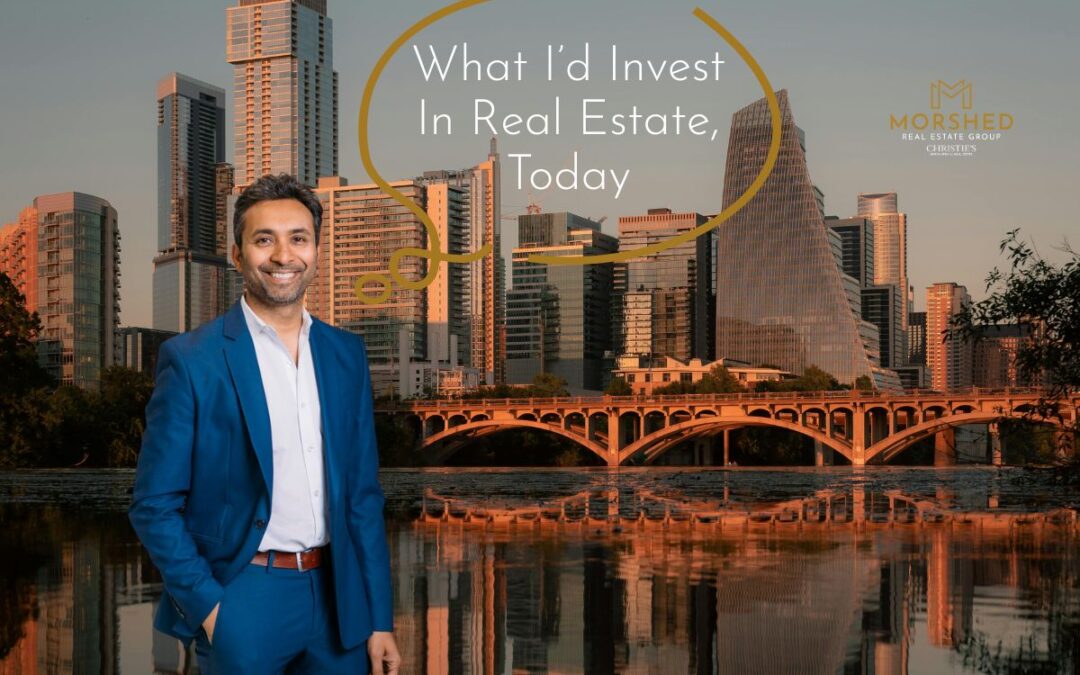
People ask me all the time, “What would you invest in today, in Austin or beyond?” The answer is not one-size-fits-all, because the right investment strategy depends on your goals, your tolerance for risk, and the season of life you are in.
For me, that answer has evolved over time.
I started in single-family investments, then moved into single-family development. From there, I expanded into covered land plays and commercial ground-up development. Each phase taught me something different about risk, timing, leverage, and how to build real wealth through real estate.
Today, my focus is a little different. I am still deeply invested in real estate, but I am more intentional about where I place capital and why. At this stage, I am looking for opportunities that allow me to de-risk while still creating strong upside. That is one of the reasons I continue to spend so much time focused on commercial real estate, especially land development.
Why land development stands out to me right now
Land development is not the right fit for everyone, but for me, it remains one of the most compelling places to be. It offers the potential to scale in a meaningful way, while also allowing for a more strategic approach to risk than some investors assume.
We are no longer in an environment where investors can rely on neat, predictable economic cycles. The old rhythm of the market does not feel as dependable as it once did. That matters, because when the cycle becomes less predictable, the quality of the strategy matters even more.
That is why I like land development as a de-risking move in this chapter. When approached correctly, it can still produce strong returns, often above 10%, while creating flexibility in how you structure, phase, and exit an investment. For investors who understand the market, the entitlement process, and the demand drivers around growth corridors, it can be a powerful way to build value without relying purely on appreciation.
A large part of my land development activity is in and around Austin, but not exclusively. I am also active outside of Texas, including in and around Raleigh and the Research Triangle, where partners and I are investing heavily in commercial land development opportunities. I continue to look at markets where long-term fundamentals, population growth, and economic drivers support real demand.
Why I still like multifamily, but selectively
I still own multifamily in a few states, and I continue to see value in the asset class. That said, I am far more selective than I used to be.
In this environment, I am less interested in deals that rely mainly on hopeful appreciation and more interested in assets that can stand on their own from a cash flow perspective. I am focused on opportunities where the cap rate makes sense, where the income is real, and where the investment can perform without needing everything to go perfectly.
That shift is intentional.
For the first 20 years of investing, a big part of my focus was on growing net worth. That phase was about building, scaling, and taking on the kinds of opportunities that could create meaningful long-term upside. Over the last five to six years, my thinking has changed. Now, I am more interested in investments with shorter two- to three-year exit windows, or assets that generate dependable year-in and year-out cash flow.
In other words, I am thinking more about stability, more about optionality, and more about what people like to call mailbox money.
Austin still offers opportunity, but not in every corner
Austin remains one of the most interesting real estate markets in the country, but I think the opportunity is more nuanced than it used to be.
This is not a market where I would suggest chasing everything. The best opportunities now tend to live in more specific pockets, with more focused strategies behind them. For me, that includes certain niche multifamily opportunities, select land development plays, and covered land positions that still offer room for value creation.
That is a big distinction.
In a market like Austin, investors can get into trouble when they confuse activity with opportunity. There is still a lot happening here, but that does not mean every deal is the right deal. The real advantage comes from knowing where demand is durable, where the path to value is clear, and where the structure of the investment aligns with your actual goals.
Austin continues to reward people who are thoughtful, not just aggressive.
Your strategy should match your stage of life
One of the biggest mistakes I see investors make is trying to copy someone else’s strategy without first asking whether it fits their own season.
What I would invest in today may not be what someone else should invest in today, and that is okay.
If you are earlier in your investing journey, you may be more focused on growth and willing to take on a longer timeline. If you are further along, you may care more about preserving capital, generating cash flow, or shortening your path to an exit. Neither approach is inherently better, but the strategy should match the objective.
That is why I always come back to the same question first: what are you actually trying to achieve?
Once you know that answer, the right opportunities become much easier to identify.
Final thoughts
If you ask me what I would invest in today, in Austin and beyond, my answer is this: I like opportunities that balance upside with discipline. I like land development because of its scalability and value-creation potential. I still like multifamily, but only when the numbers and cash flow truly support the deal. And more than ever, I believe the smartest investment strategy is the one that reflects both the market you are in and the life you are building.
Real estate can still be one of the best wealth-building tools available, but in this market, success is less about chasing the loudest trend and more about making clear, well-timed decisions with the right strategy behind them.
If you are thinking through your own next move, whether in Austin or beyond, my team and I are always happy to talk through your goals, your timeline, and the kinds of opportunities that may fit where you are headed.