
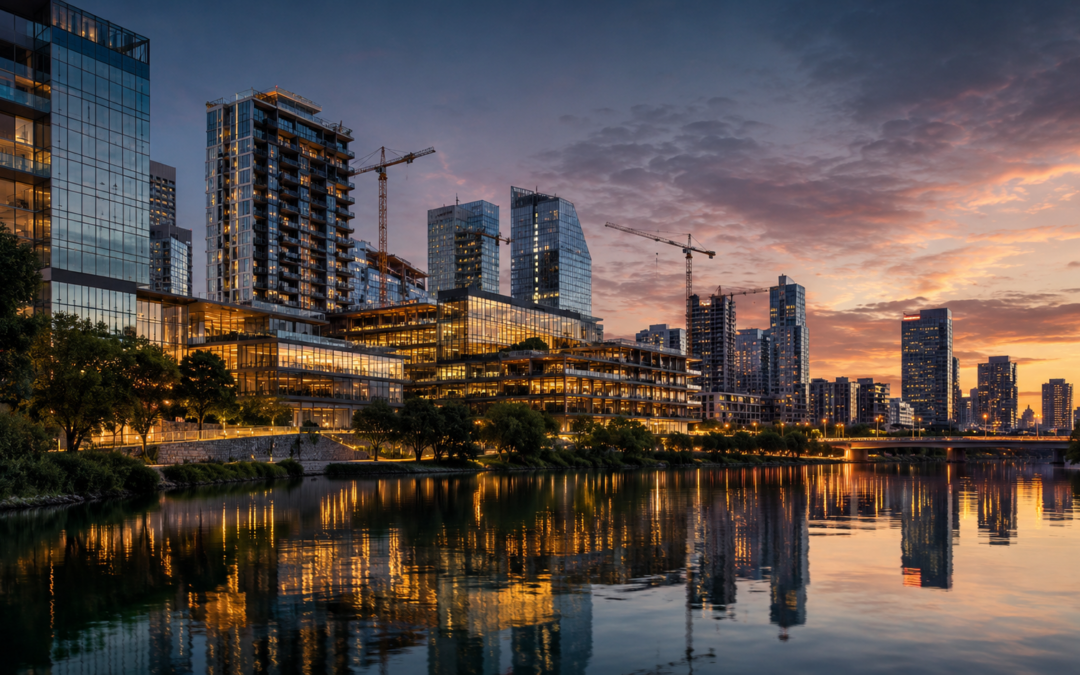
Some Austin real estate stories are not just about what is being built next. They are about what a site reveals while the market is still deciding what comes next.
The former Austin-American Statesman property on Lady Bird Lake is one of those stories.
Located at 305 S. Congress Avenue, the nearly 19-acre waterfront site has long been viewed as one of Austin’s most important redevelopment opportunities. It sits just south of downtown, directly along one of the city’s most visible urban edges, in an area that has been central to the larger South Central Waterfront vision.
For years, the conversation around the site has focused on what it could become: a major mixed-use district with residential, hotel, office, retail, restaurants, public space, trail improvements, and stronger connections between South Congress, Lady Bird Lake, and downtown Austin.
But before that next chapter arrives, the property is telling a different kind of story.
While long-term redevelopment remains delayed, part of the former newspaper facility has found temporary new life as a battery production space for Base Power, an Austin energy startup. In a building once associated with newspaper printing and distribution, the current use now points toward energy storage, grid reliability, manufacturing, and Austin’s continued evolution as a center for technology and infrastructure innovation.
That shift is worth watching.
A Rare Site at the Center of Several Austin Stories
The former Statesman site is not just valuable because it is large. It is valuable because of where it sits.
Waterfront land near downtown Austin is increasingly scarce. Large redevelopment sites in the urban core are even more limited. A property that combines both, while sitting along Lady Bird Lake and near South Congress, carries a level of strategic importance that goes beyond a typical commercial real estate opportunity.
That is why this site continues to draw attention, even while its long-term redevelopment timeline remains uncertain.
It touches several of Austin’s most important real estate themes at once: density, waterfront access, public space, downtown expansion, environmental scrutiny, infrastructure, mobility, and the question of how Austin should grow around its most visible natural assets.
In other words, this is not just a site plan. It is a test case.
Why the Temporary Use Matters
The Base Power lease is interesting because it is not the expected use for one of Austin’s most prominent waterfront properties.
That is exactly why it matters.
A temporary production facility on a future mixed-use redevelopment site says a lot about the current market. It shows how owners are looking for practical interim uses while major projects move through legal, financial, and planning complexity. It also shows how Austin’s commercial real estate market is becoming more flexible, especially as companies look for functional space that can support growth quickly.
For Base Power, the site offers room to test and scale production while the company plans for a larger long-term facility. For the property ownership, the lease helps activate a major asset while redevelopment remains paused.
For Austin, it creates a striking snapshot of where the city is right now: legacy media space becoming energy technology space, on land that may eventually become one of the most significant mixed-use districts in the city.
That is not a small detail. It is a signal.
The Bigger Real Estate Lesson
The former Statesman site highlights a broader truth about Austin real estate today: the best opportunities are not always found in finished projects. Sometimes they are found in the transition period.
That is where the market reveals the most.
A site like this shows how much is happening beneath the surface before cranes arrive. Legal challenges, public infrastructure, environmental concerns, capital markets, tenant demand, adaptive reuse, and long-term land strategy all shape what becomes possible.
For investors, owners, and buyers, that matters because the future value of a property is often influenced long before the final version is visible.
The question is not only what will be built here. The better question is what this site tells us about Austin’s next phase.
What This Site Signals About Austin’s Future
The former Statesman property sits at the intersection of several long-term trends.
First, Austin’s waterfront is becoming more contested and more valuable. As the city grows, the balance between private development, public access, environmental protection, and urban density will only become more important.
Second, mixed-use development remains central to Austin’s future, but the path from vision to execution is becoming more complex. Large projects must now navigate not just market conditions, but also public expectations around green space, affordability, walkability, traffic, and neighborhood impact.
Third, adaptive reuse and interim activation are becoming more relevant. In a changing market, not every high-value site moves directly from old use to new construction. Some properties may have temporary chapters that still create economic activity, support growing companies, and keep important locations from sitting idle.
Finally, Austin’s identity as a technology city is expanding. The Base Power use connects real estate to energy infrastructure, manufacturing, and grid resilience, all of which are becoming more important as Texas continues to grow.
Why We Are Watching It
The former Statesman site is one of the most interesting real estate stories in Austin because it is not just about a single property. It is about the city’s direction.
It shows how Austin is wrestling with growth at its most visible edges. It shows how commercial space can be reimagined while long-term development plans remain in motion. It shows how infrastructure, energy, public space, and real estate are becoming more connected.
And it shows why local perspective matters.
At The Morshed Group, we watch these shifts not just to track what is new, but to understand what they mean. Major development stories like this can influence surrounding property values, buyer interest, investor strategy, commercial demand, and the way people think about entire districts.
The former Statesman site may eventually become a major mixed-use destination on Lady Bird Lake. For now, its temporary chapter may be just as revealing.
Austin’s next real estate story is not always waiting at the ribbon cutting.
Sometimes, it is already sitting in the space between what a property was and what it is about to become.